| Official name | Republic of Poland (Rzeczpospolita Polska) |
| Capital | Warsaw (Warszawa) |
| Population | ~37.8 million (official); ~38.9 million including unregistered residents (GUS, 2025) |
| Area | 312,696 km² — 5th largest country in the EU |
| EU member since | 2004; Schengen Area member |
| Currency | Polish złoty (PLN, symbol: zł) — Poland does not use the euro |
| Official language | Polish |
| Time zone | CET (UTC+1); CEST in summer (UTC+2) |
| President (2026) | Karol Nawrocki (elected June 2025) |
| Prime Minister | Donald Tusk (since December 2023) |
🏙 Capital
Warsaw (Warszawa) is home to approximately 1.9 million people in the city proper, with the greater metropolitan area reaching around 3.1 million. It is Poland’s political, financial, and media centre — and by far the country’s most expensive city to live in.
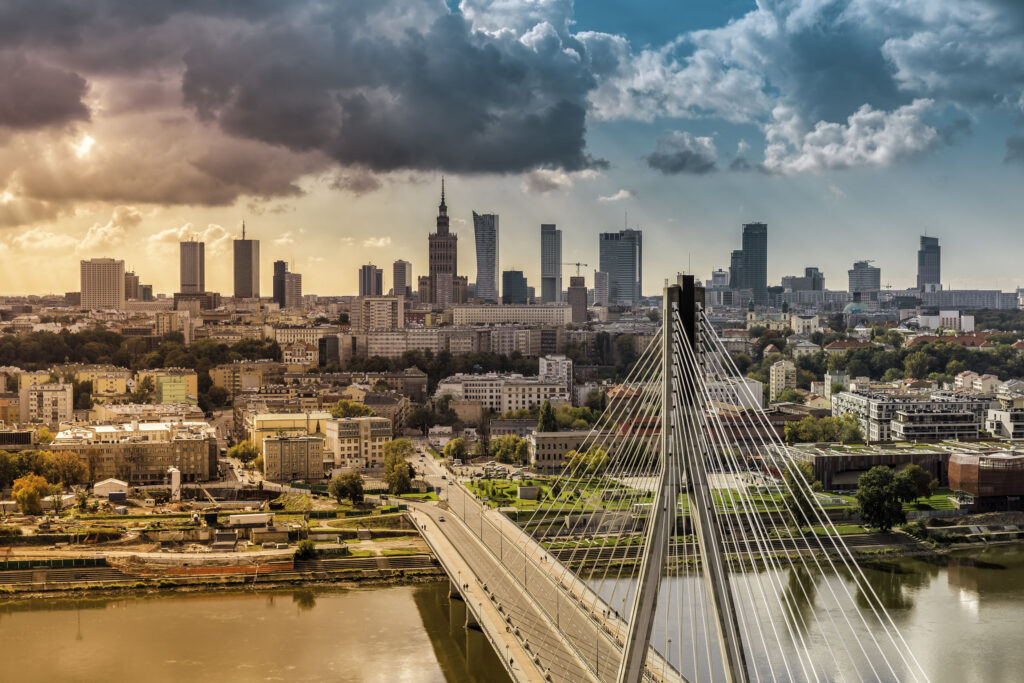
Warsaw was almost entirely destroyed in World War II and rebuilt from scratch, which is why large parts of the city have a distinctive post-war architecture alongside a reconstructed UNESCO-listed Old Town. Today it’s one of the fastest-growing capitals in Central Europe, with a booming tech sector, a large international business community, and over 300,000 foreign residents — about 14.5% of the city’s population.
Other major cities:
| City | Population |
|---|---|
| Kraków | ~814,000 |
| Wrocław | ~675,000 |
| Łódź | ~666,000 |
| Poznań | ~526,000 |
| Gdańsk | ~466,000 |
| Szczecin | ~399,000 |
🌐 Administrative Divisions of Poland
Poland has three main levels of local administration:
- Voivodeship (Województwo)
- County (Powiat)
- Municipality (Gmina)
Cities may also be divided into districts (Dzielnica).
Voivodeship (Województwo)
A Voivodeship is the largest administrative region in Poland.
There are 16 Voivodeships.
Each Voivodeship has its own:
- Voivodeship Office (Urząd Wojewódzki)
- Marshal’s Office (Urząd Marszałkowski)
- Regional Government
County (Powiat)
Each Voivodeship is divided into Powiats.
Poland has:
- 314 Counties (Powiaty)
- 66 Cities With County Rights
County offices are called Starostwo Powiatowe.
Municipality (Gmina)
The Gmina is the basic unit of local government. There are 2,477 Gminas in Poland.
Most everyday administrative matters are handled here.
The local office is called:
- Urząd Gminy
- Urząd Miasta
- Urząd Miasta i Gminy
District (Dzielnica)
Some large cities are divided into Districts.
For example, Warsaw has 18 Districts, including:
- Mokotów
- Wola
- Ursynów
- Praga-Północ
- Praga-Południe
- Bielany
- Bemowo
- Śródmieście
District offices handle many local administrative matters on behalf of the city.
Example
If you live in Warsaw, Mokotów, your administrative structure looks like this:
| Administrative Level | Example |
|---|---|
| Country | Poland |
| Voivodeship | Masovian |
| County | Warsaw |
| District | Mokotów |
🏔️ Geography
Poland sits in the geographical centre of Europe, sharing borders with seven countries:
- West: Germany
- Southwest: Czech Republic
- South: Slovakia
- East: Ukraine and Belarus
- Northeast: Lithuania and Russia (Kaliningrad exclave)
- North: Baltic Sea coastline (~770 km)
The landscape is mostly flat lowland — the North European Plain stretches across most of the country. The south rises into the Carpathian and Sudeten mountain ranges, with the Tatra Mountains on the Slovak border reaching over 2,000 metres. Major rivers: the Vistula (Wisła) and the Oder (Odra).
Poland has no natural barriers on its eastern and western borders — historically both a geopolitical vulnerability and a reason for the country’s flat, accessible terrain that supports heavy agriculture and logistics infrastructure.
🌦️ Climate
Poland has a temperate continental climate — warm summers, cold winters, variable spring and autumn. The east is more continental (colder winters, hotter summers); the west is more maritime (milder, more rain).
| Season | Months | Typical temperatures | What to expect |
|---|---|---|---|
| Winter | Dec–Feb | −10°C to +5°C | Snow frequent, especially in mountains and east; frost common in all cities |
| Spring | Mar–May | 3°C to 20°C | Mild and rainy; unpredictable — can snow in March |
| Summer | Jun–Aug | 15°C to 35°C | Warm to hot; thunderstorms common; heatwaves increasingly frequent |
| Autumn | Sep–Nov | 6°C to 15°C | Cooling rapidly; grey, rainy October–November |
💵 Currency
Poland uses the Polish złoty (PLN, zł). Despite being an EU member since 2004, Poland has not adopted the euro and has no fixed date to do so.
You cannot pay in euros in regular Polish shops, restaurants, or services. Some tourist areas and hotels accept euros informally, but at poor rates.
Exchange rates (mid-2026, approximate):
| Currency | PLN equivalent |
|---|---|
| 1 USD | 3.80–4.00 PLN |
| 1 EUR | 4.20–4.30 PLN |
| 1 GBP | 4.90–5.10 PLN |
| 1 UAH | ~0.09–0.10 PLN |
| 1 GEL | ~1.40–1.50 PLN |
The best exchange rates are at kantors (private currency exchange offices) — significantly better than airports, banks, and hotels. In cities, kantors are found in shopping malls, near train stations, and in pedestrian streets. (Read our article about How to Exchange Money in Poland)
👨🏿🦱 Foreigners in Poland
The number of foreigners with residence permits in Poland has reached two million, making up just over 5% of the country’s 37.5 million inhabitants, according to data released by the Office for Foreigners (UdSC) in April 2026.
That figure covers only those with valid residence permits. The two-million total does not include short-stay visa holders or people entering visa-free, meaning the true number of foreigners present in Poland on any given day is materially higher.
Top nationalities (residence permits, April 2026)
Over three quarters of those with residence permits are Ukrainians (1.55 million), with the next largest groups being Belarusians (139,300), Indians (26,100), Georgians (22,200), Russians (19,500), Vietnamese (15,100) and Turks (14,500).
| Rank | Nationality | Number with valid permits |
|---|---|---|
| 1 | 🇺🇦 Ukrainian | 1,550,000 |
| 2 | 🇧🇾 Belarusian | 139,300 |
| 3 | 🇮🇳 Indian | 26,100 |
| 4 | 🇬🇪 Georgian | 22,200 |
| 5 | 🇷🇺 Russian | 19,500 |
| 6 | 🇻🇳 Vietnamese | 15,100 |
| 7 | 🇹🇷 Turkish | 14,500 |
Where foreigners live
The largest numbers of foreigners live in Warsaw (301,200), Wrocław (153,800), Kraków (101,400) and Poznań (73,860).
In 2023, 105,404 students from 179 countries were studying in Poland. Foreign students made up 8.61% of the total student population.
Polish citizenship granted to foreigners
Poland set a record in 2025: 19,135 foreigners were granted Polish citizenship — a 17% increase compared to the previous year. Ukrainians accounted for over 53% of grants (10,295), followed by Belarusians (6,519) and Russians (763).